
Questions to Ask About a BookWithout turning reading into a quiz
Find questions to ask before, during, and after reading with your child. Choose one that fits the book, listen to the answer, and let your child decide how much to share.
Try ENGAGE Read the guide ↓Choose a question you want to hear answered
Ask about what caught your child’s attention, what they would choose, or what they want to return to. Ask one question, listen to the answer, and leave room to keep reading.
A question becomes a quiz when you are waiting for a particular answer and checking whether your child gives it. During family reading, you are also allowed to ask because you do not know what your child thinks.
Knowing the answer does not automatically make a question a test: “Where’s the cat?” can be a game you both enjoy when your child is free to join in or keep reading.
Questions about the plot are not forbidden. If either of you lost track of who is speaking, figure it out together. The difference is whether you are helping each other follow the story or testing your child at every pause.
Before asking, check: Am I curious about their answer, or trying to get them to agree with mine?
If you already know what you want them to say, try sharing your own thought instead.
The questions below are examples to choose from, not a reading plan to complete. Use words that sound like you. Skip anything that does not fit the book or your child.
Questions to ask before reading
Begin with a choice or a detail that is already there. A cover, a title, or a familiar character gives you something to discuss without asking your child to predict the whole story.
“Which of these would you like us to read?”
Offer books you are willing to read. A reread is a valid choice.
“What caught your eye on the cover?”
Look at the detail your child names or points to before adding your own.
“Would you like me to read, or shall we take turns?”
Taking turns is an invitation. Do not turn it into a required reading exercise.
“What do you remember liking about this one?”
Use this for a familiar book. It is fine if your child wants to open it and start instead.
If your child is ready to read, begin. You do not have to ask a question before the first page.
Questions to ask while reading
Wait for a pause or something your child notices. Avoid interrupting a scene they want to hear. A brief comment or a shared laugh is also a response.
“Which part are you looking at?”
Follow their attention. It may be a background detail rather than the main action.
“If you could spend an afternoon in one place in this book, which would you choose?”
Use this when the story offers places to choose from. Accept the choice without requiring a reason.
“What would you want to ask that character?”
Let your child decide what interests them. Do not supply the question you hoped they would ask.
“Would you keep that part of the story or change it?”
Listen to their idea without turning the answer into a task to rewrite the book.
When your child shares something from their life
Listen before adding another question. If they say, “That happened at lunch,” try, “I’m listening.” Let them decide what to tell you. Do not use the story to press for names or details.
When you want to share too
Add your own preference or thought after listening. “I would choose the rooftop because I like looking down at a city” is a contribution, not the answer your child needs to copy. Only use it if the book actually includes a rooftop and it is true for you.
Questions to ask after a book, and when to stop
The last page does not have to lead to a discussion. If your child wants to linger, try one of these. If they want to stop, close the book.
“Is there a picture you want to look at again?”
Return to the picture together. Your child does not have to explain the choice.
“What are you still wondering about?”
You do not have to settle every question. It is fine to wonder together.
“Would you choose this book again?”
Accept a no. You and your child are allowed to like different books.
“What would you like us to read next?”
Use the answer when you next choose a book, within the options available to you.
If the answer is “I don’t know”
Accept it. You might say, “Okay,” and keep reading. Do not reword the same question repeatedly until your child answers.
If you receive a short answer
A name, a gesture, or a few words is an answer. Respond to what was offered instead of automatically adding “Why?” Give your child room to say more on their own.
Leave out questions that decide for your child
“You’re scared like him, aren’t you?” supplies a feeling before your child has named one. “What lesson did you learn?” asks them to produce a lesson. During family reading, try listening to what they noticed or sharing your own response instead.
Questions parents ask
How many questions should I ask about a book?
There is no required number. Start with one if something makes you curious, then attend to the response. Some readings need no questions at all.
What if my child does not answer with words?
Offer room to point, use their usual communication tools, return to a picture, or keep listening. Do not require a spoken answer or eye contact.
Are these reading-comprehension questions?
This page is for family reading and learning about each other. It is not a comprehension assessment. If your child wants help understanding an event or word, explore it together without testing every page.
Choose a book for what is happening in your family
These guides pair a short book selection with ways to notice and respond while you read together.
- Books about anxiety for kids
- Books about divorce for children
- Books for reluctant readers
- Books about grief for kids, including losing a pet
- Books about bullying for kids
- Books about moving for kids
- Books about a new baby
Explore the benefits of reading with your child, or learn what dialogic reading is and how ENGAGE is different.
Read more about The ENGAGE Method®, the approach behind Reading To Connect.
Who wrote this
Quinn Cummings, Certified Family Life Educator (CFLE-P), is the founder of Reading To Connect. She built The ENGAGE Method® to help caregivers notice and respond to their children while reading together. Read about Quinn and her work.
The examples on this page are suggestions for family reading. They are not a test of your child or a list to complete.
Find guidance for the book you’re reading in ENGAGE
ENGAGE has book-specific guidance for reading together, with ideas for what to say and notice. Your child decides what to share, whether to answer, and when to turn the page.
Type in your book. See its information.
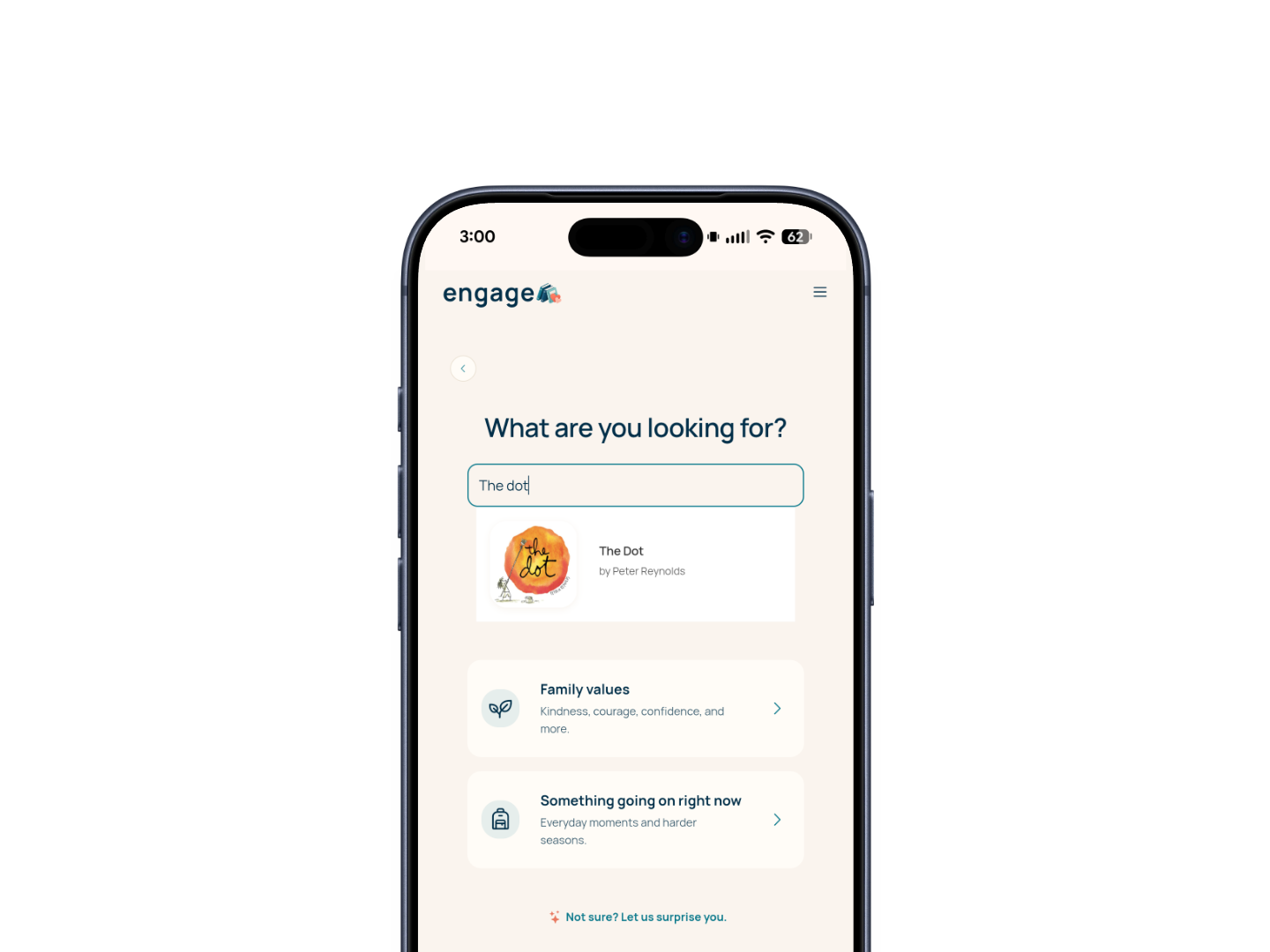
After you sign up, enter your book’s title. If it’s in the ENGAGE catalog, select it to see its information and book-specific guidance. Here’s an example with The Dot.
Try ENGAGE Tap a step to see the screen.01Type in your book
Enter the title in the search field, then select your book from the results.
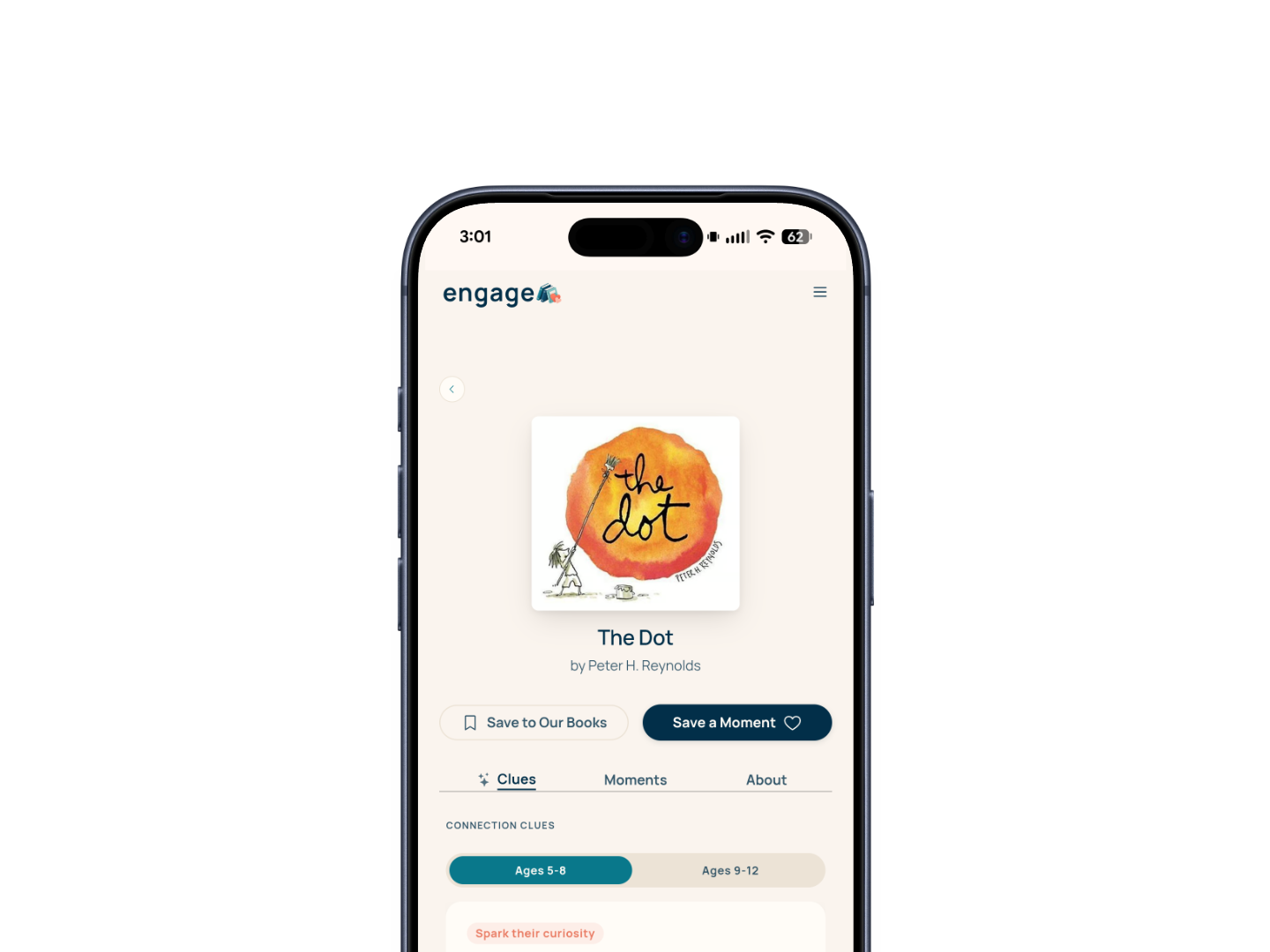
02See your book’s information
Select the book to open its page. Use “About” to see information about the book.
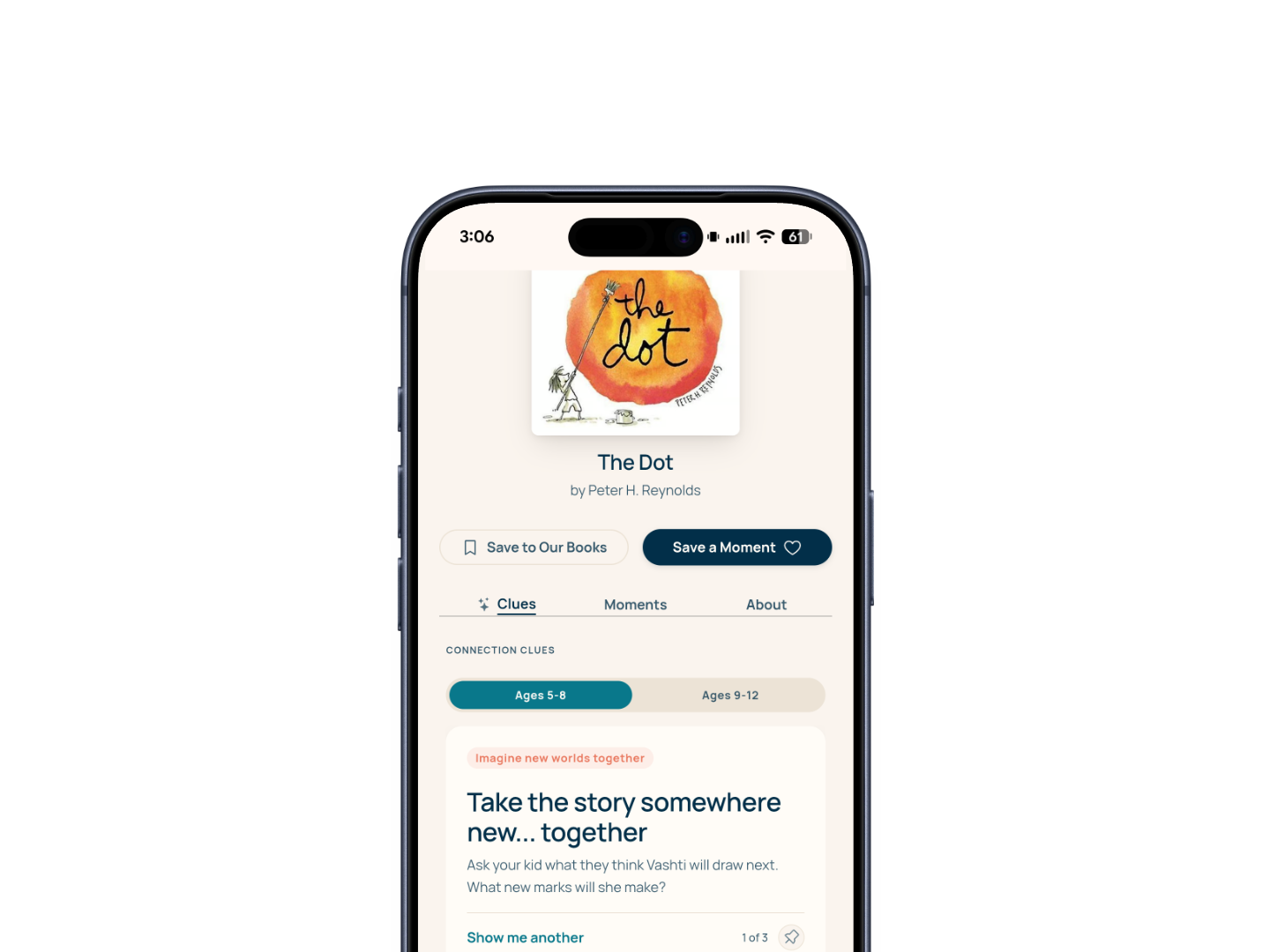
03Find guidance for reading together
Open “Clues” and choose the age band that fits your child. Read the book-specific guidance and choose what fits your time together.
Sign up for ENGAGE to find guidance for reading a book together.
Sign up for ENGAGE14 days free, then $6.99/month at the founding price. No card required for the trial. Works in your browser.