

By Quinn Cummings, Certified Family Life Educator (CFLE-P), founder of Reading To Connect and creator of The ENGAGE Method®
If your child feels left out at school, listen to what happened before trying to solve it. Ask what they need you to understand, make a brief record of the concern, and work with the school when exclusion continues or your child feels unsafe. You do not need to settle on the word “bullying” before asking for help.
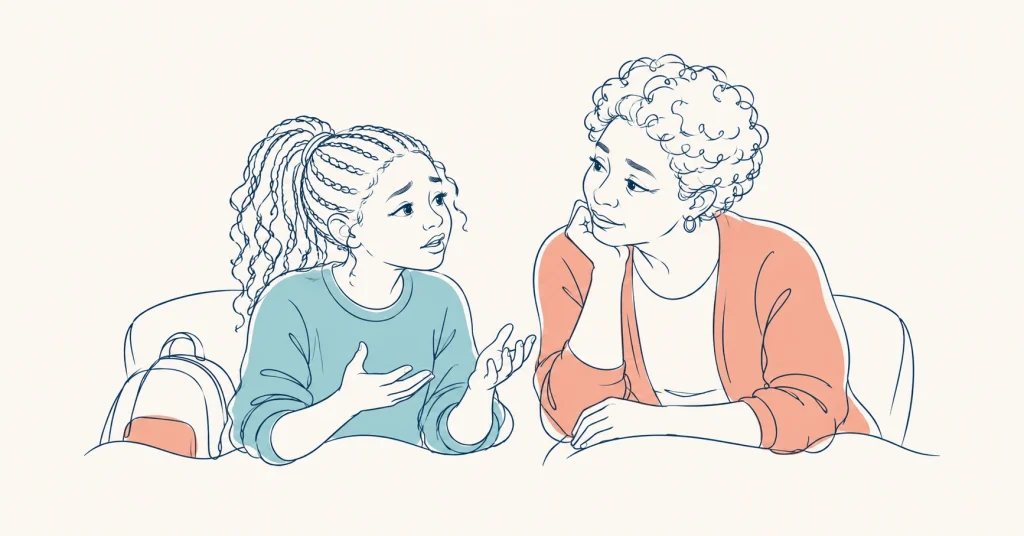
Hearing “Nobody likes me” can leave you wanting to reassure your child immediately. But “Of course they do” may move past the part they were trying to tell you. Start with something you can stand behind: “I’m glad you told me. I want to understand.”
Listen before offering a solution
Let your child begin where they want. You might ask, “What happened today?” If they say they were alone at lunch, stay with that moment instead of asking for a report on every friendship.
A younger child may show you where people were sitting. An older child may prefer to talk while you are doing something side by side, or write it down. Let them use the way of communicating that works for them.
You can say, “That sounds like it hurt.” Avoid promising that everyone will be friends tomorrow. You can promise to take their concern seriously and help work out what happens next.
If they do not want to explain more, stop pressing. Say when you will check in again. For everyday school conversation outside a specific concern, see questions to ask instead of how was your day.
Understand what being left out means here
Having few friends, enjoying time alone, and being deliberately excluded are different situations. Ask what your child wants to be different. Do they want someone to sit with? Are they being told they cannot join? Did one difficult afternoon follow a disagreement?
A child’s “I have no friends” deserves attention even before you know its full meaning. Avoid turning it into an argument over whether they can name one friend.
StopBullying.gov defines bullying as unwanted aggressive behavior involving a real or perceived power imbalance and repetition, or the potential for repetition. Deliberately excluding someone can be social bullying. Not every disagreement meets that definition, but distress and harmful behavior still deserve a response.
Listen for what is being said and done. If the concern involves race, disability, language, religion, or another part of your child’s identity, name those details when you contact the school. Do not reduce them to a problem your child should solve by fitting in better.
Write down enough to follow up
After listening, make a brief note. Keep your child’s account separate from what you observed or what another adult reports. You do not need a perfect record before contacting someone.
Use these fields:
- When and where: Date, approximate time, and setting, if known.
- What your child reported: Their words where you remember them accurately. Mark uncertainty rather than filling gaps.
- What you observed: Changes or incidents you personally saw.
- Who may know more: Staff members or witnesses your child identified.
- Next step: Person contacted, response received, and agreed follow-up date.
For example, an entry might read: “Monday, lunch. Child reports being told the seat was saved, then seeing another child sit there. I did not observe it. Ask lunch staff what they have noticed.” This is an illustrative record, not a conclusion about motive.
Keep the note private. Avoid posting names or screenshots in parent groups to gather opinions.
Contact the school with a specific request
The American Academy of Pediatrics recommends teacher involvement when rejection forms a pattern, including observations from lunch and recess staff. You can seek help sooner when there is a safety concern or a serious incident.
Tell your child what you plan to share. Ask what worries them about adult involvement. Their concern matters, even when protecting them requires you to act.
Here is an email you can adapt:
Subject: Request to discuss support for [child’s name] during [setting]
Hi [teacher’s name],
[Child’s name] told me that [brief description of what they reported] during [setting/date]. I did not witness it, and I would appreciate your help understanding what is happening.
Could you check with the adults who supervise that setting and let me know what they have observed? I would also like to discuss what support can be in place and who [child’s name] can go to during the school day.
[Child’s name] is concerned about [specific concern, if applicable]. Please consider that as we plan how to respond.
Could we arrange a time to talk and agree on when we will check whether the support is helping?
Thank you,
[Your name]
If there were threats, injury, discriminatory comments, or an immediate safety issue, state that plainly and contact the appropriate school staff promptly. Do not wait for a routine email response when immediate help is needed.
Agree on what happens after the conversation
Ask for a plan you can understand: who will observe the setting, which adult your child can approach, what support will be offered, and when you will hear back.
At the follow-up, ask about what has changed. “We spoke to the children” does not tell you whether your child now has safe access to lunch, recess, or the activity where the problem occurred.
If the response has not addressed the concern, contact the counselor or principal with the same factual record and ask for the next step under the school’s process. Include your child’s account of how the plan is working.
StopBullying.gov’s guidance for supporting children emphasizes ongoing school-family communication and follow-through. It also cautions against blaming the child or treating bullying as an equal-power conflict requiring peer mediation. Your child should not have to agree to friendship or affection as the price of adult support.
Support belonging beyond this one setting
Ask where your child feels comfortable and with whom. That might be a cousin, a neighbor, a teammate, or someone who shares an interest. Look for accessible ways to spend time together, without promising that a new group will solve the school problem.
Child Mind Institute’s guidance on loneliness includes helping children find settings that fit their interests. An opportunity should fit your child and your family’s resources. It does not have to be a paid activity or a large social event.
If your child wants to rehearse asking to join a game, you can practice together. Make that an offer. It should not become evidence that the exclusion was their fault.
If distress persists or affects school attendance, sleep, or everyday life, ask your child’s pediatrician or a qualified mental health professional for support.
Offer a book when your child wants one
Once you have attended to the concern, reading together can be an ordinary way to spend time with your child. They may welcome a related story, or want something entirely different.
The Day You Begin, written by Jacqueline Woodson and illustrated by Rafael López, explores feeling different and beginning to connect with others. It is one possible invitation, not a promise that sharing more will make other children welcoming.
Offer it without assigning your child a character. You might say, “Would you like this one, or something else?” If they choose it, you can read without asking them to explain how the story matches school.
For support with reading together, explore ENGAGE. You can also browse the RTC guide to books about bullying. Keep any school follow-up moving whether or not your child wants to read.
For tonight, listen to the account they are ready to give. Agree on the next adult action, and let them know when you will return to it.

