
Benefits of Reading With Your ChildBeyond literacy, notice the time you share.
Reading with your child brings words, pictures, and your attention into the same activity. Alongside literacy, it offers time to learn what interests each of you, hear another person’s ideas, and respond to one another.
Try ENGAGE Read the guide ↓What shared reading offers
The benefits of reading with your child are often described in terms of vocabulary and early literacy. Family reading also gives you a shared subject: something to look at, react to, and return to together.
The American Academy of Pediatrics recommends shared reading from birth through at least kindergarten and describes both language-rich interaction and caregiver-child relationships as reasons to encourage it. Read the AAP’s 2024 policy statement.
The examples below are Reading To Connect’s suggestions for using that time. They do not establish that a particular book or The ENGAGE Method® produces a measured result.
What you learn about each other
What catches your child’s attention
Your child stops at a tiny cat in the corner of a picture. You had been following the main character. Going back to the cat lets your child influence what you look at together.
How you each understand a character
You think a character looks worried. Your child thinks they look annoyed. Say what you noticed, then listen to their account. The point of this exchange is to hear each other, not to settle on the adult’s answer.
Which memories a book brings up
A picture of a garden reminds you of a place you knew as a child. Share one detail if it fits. Your child is free to listen, add something, or return to the story.
What the caregiver brings and learns
In The ENGAGE Method®, I treat the caregiver as a participant who can learn, reconsider, remember and enjoy the reading too. A child’s interpretation can change yours; a memory you share can help them know you. Your time and energy matter when deciding how to read together. Neither of you owes the other a response.
Make room for a response
Choose a book you are both willing to spend time with. Read a little, pause when something interests either of you, and respond to what the other person actually says or does.
Child: “That dog is in every picture.”
Caregiver: “You noticed him before I did. Let’s look back.”
This exchange stays with a detail the child chose. It does not require a personal disclosure or a lesson at the end.
If you want more examples, read how to connect with your child through reading and questions to ask about a book.
Keep family reading flexible
Some readings include laughter and plenty of talk. Others are quiet. Neither gives you enough information to judge the quality of your relationship.
- Let a reread stay a reread. Your child does not owe a new response each time.
- Offer to read aloud even when your child reads independently.
- Stop or change books when either of you has had enough.
- Keep required school practice separate from time spent enjoying a book together.
The ENGAGE Method® focuses on how a caregiver and child respond to each other while reading. Its relational purpose is distinct from a promise of literacy progress or a clinical result.
Questions about reading together
Is reading aloud still useful when my child reads independently?
It remains an option for time together. Ask whether your child wants to listen, take turns, or show you something they are reading. Let their preference guide the format.
How long should we read?
There is no required length for the examples on this page. Read for the time you both want to share. Finishing the book is optional.
Does every reading need questions?
No. A comment, a laugh, pointing at a detail, or quietly listening are all ways to participate.
Who wrote this
Quinn Cummings, Certified Family Life Educator (CFLE-P), is the founder of Reading To Connect. She built The ENGAGE Method® to help caregivers notice and respond to their children while reading together. Read about Quinn and her work.
This page draws on the AAP’s shared-reading guidance and the family research described below. Its reading examples describe Reading To Connect’s approach to family reading; they are not findings from a study of ENGAGE.
Research on the caregiver’s experience
A 2021 diary study in Germany during COVID-19 restrictions found day-to-day links in both directions between parents offering children choices within limits and parents’ own sense of choice, competence and connection. All measures came from parents’ reports. This was observational family research, not a shared-reading intervention or a test of ENGAGE; it does not establish cause and effect.
This research gives me a reason to consider the caregiver’s experience alongside the child’s when developing reading guidance.
Neubauer, A. B., Schmidt, A., Kramer, A. C., & Schmiedek, F. (2021). A Little Autonomy Support Goes a Long Way. Child Development, 92(5), 1679–1697.
How to cite this guide
Cummings, Quinn. “Benefits of Reading With Your Child.” Reading To Connect. Updated October 20, 2026.
Suggested attribution (paraphrase): Quinn Cummings, CFLE-P, founder of Reading To Connect and creator of The ENGAGE Method®, describes the caregiver as a participant who can learn, reconsider and share memories during reading, with the caregiver’s time and energy helping shape the experience.
Link to this guide when using that paraphrase. If quoting directly, use the exact words from the passage you quote. Credit findings from the research note to Neubauer and colleagues.
Find guidance for the book you’re reading in ENGAGE
ENGAGE has book-specific guidance for reading together, with ideas for what to say and notice. Your child decides what to share, whether to answer, and when to turn the page.
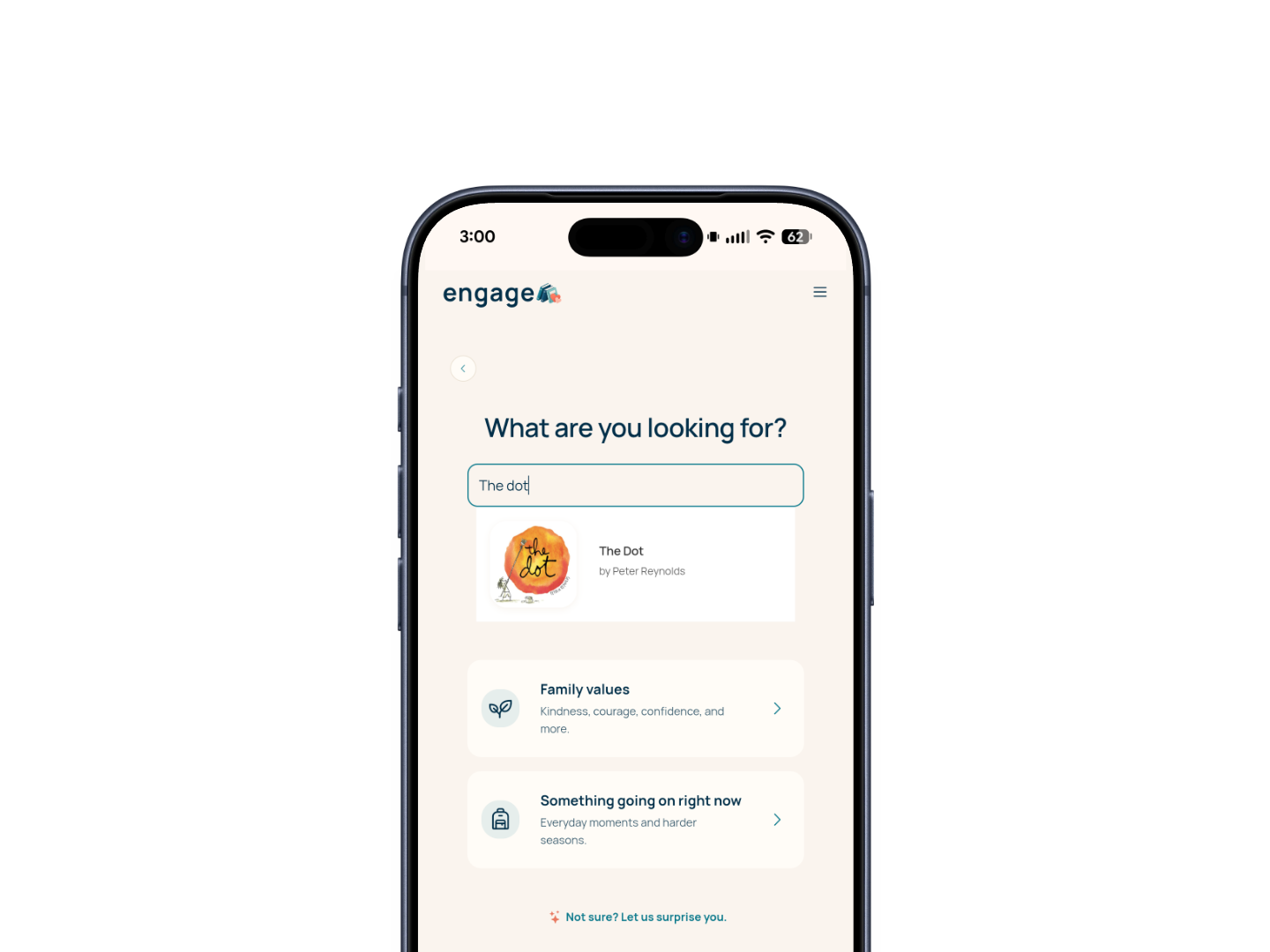
Type in your book. See its information.
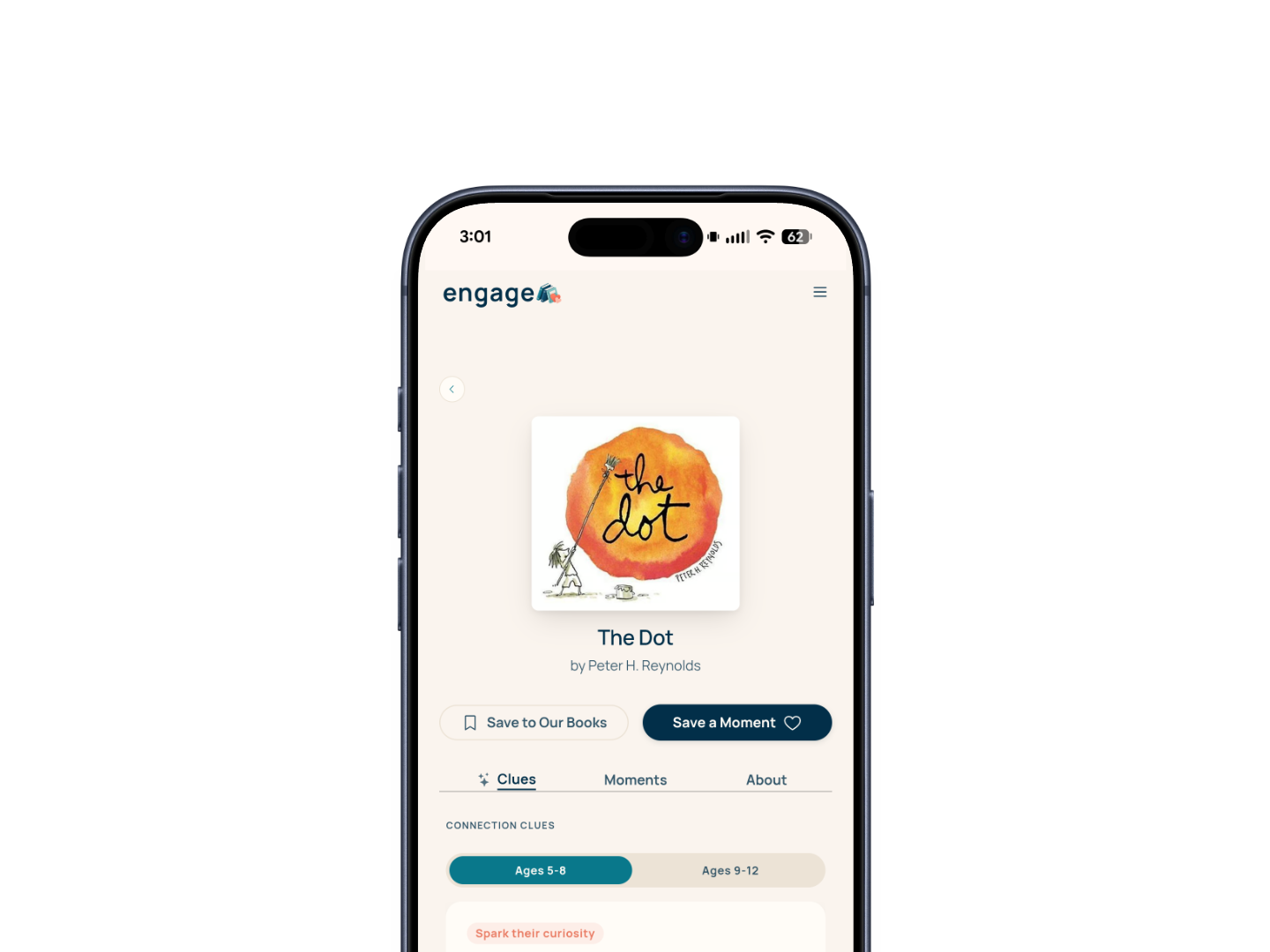
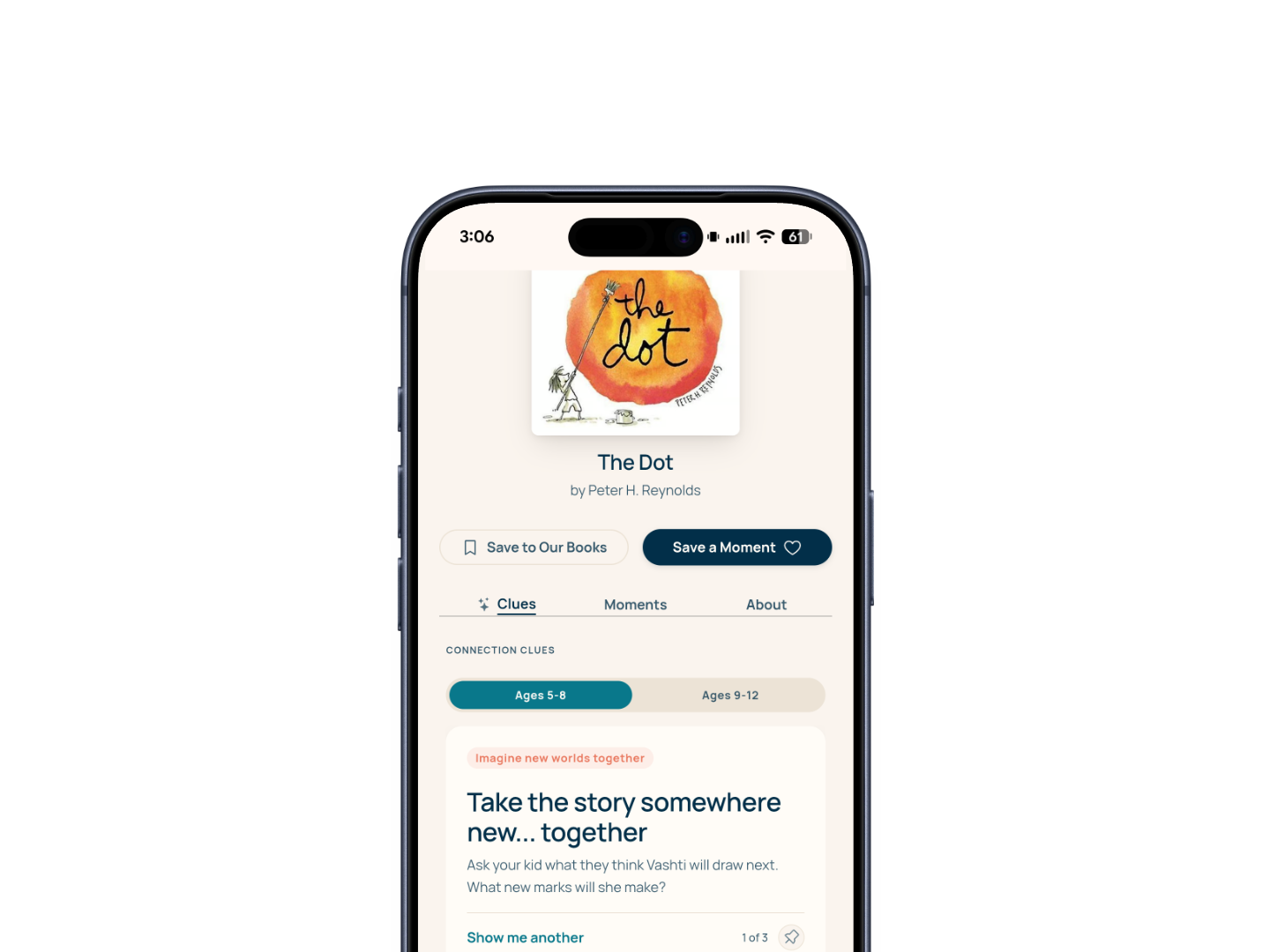
After you sign up, enter your book’s title. If it’s in the ENGAGE catalog, select it to see its information and book-specific guidance. Here’s an example with The Dot.
Try ENGAGE Tap a step to see the screen.01Type in your book
Enter the title in the search field, then select your book from the results.
02See your book’s information
Select the book to open its page. Use “About” to see information about the book.
03Find guidance for reading together
Open “Clues” and choose the age band that fits your child. Read the book-specific guidance and choose what fits your time together.
Sign up for ENGAGE to find guidance for reading a book together.
Sign up for ENGAGE14 days free, then $6.99/month at the founding price. No card required for the trial. Works in your browser.